
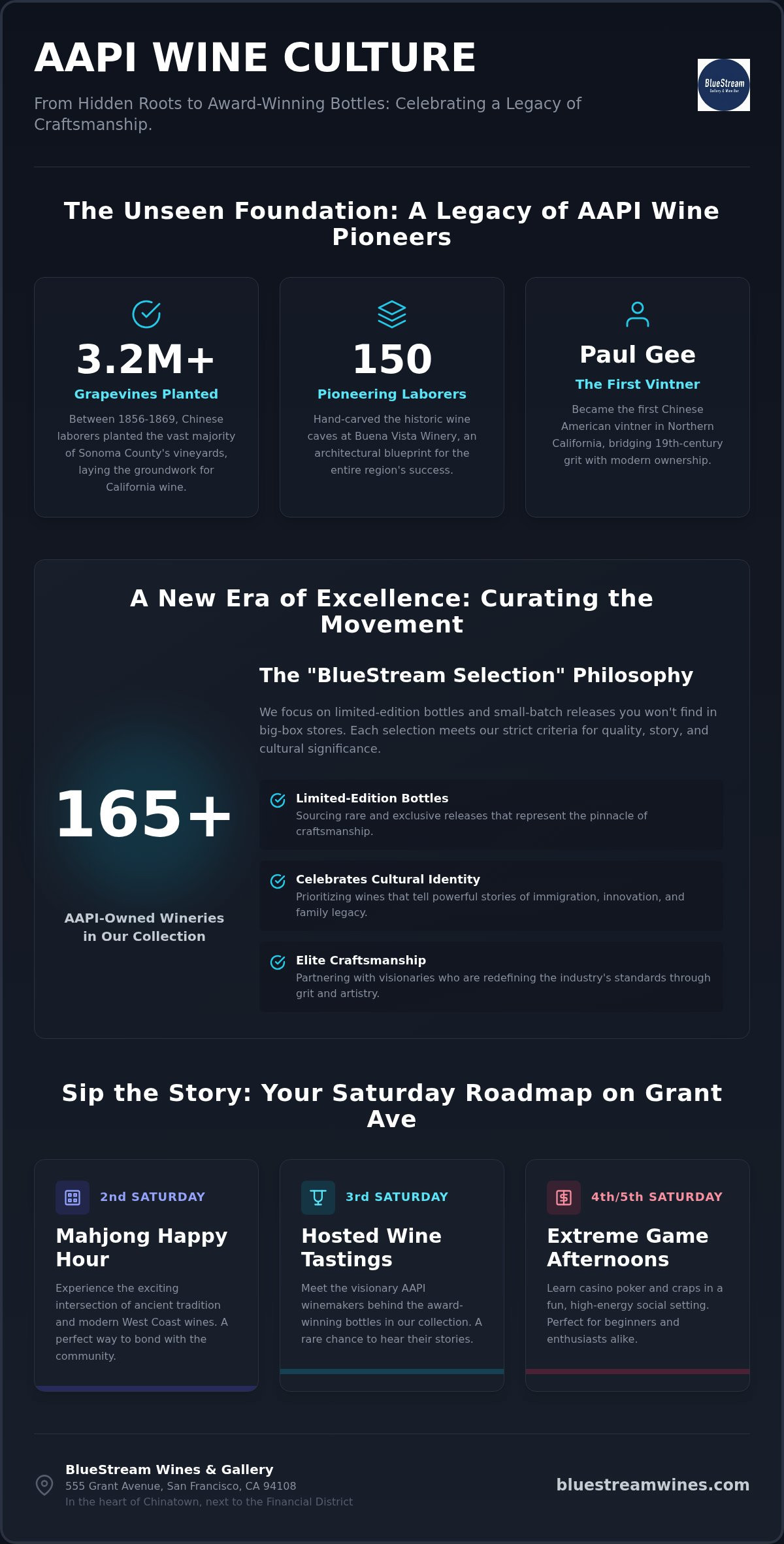
Did you know that Chinese laborers planted the majority of Sonoma County's 3.2 million grapevines between 1856 and 1869? It's a staggering statistic that highlights how deep AAPI contributions to American wine actually run. You've likely noticed these stories are often left out of mainstream education, making it tough to find AAPI-owned brands in big-box stores. We agree that this heritage deserves to be celebrated with pride rather than hidden in the archives.
Today, we're bridging that gap by exploring the powerful history and vibrant future of AAPI winemaking. You'll discover the legacy of 19th-century pioneers and meet modern visionaries crafting award-winning bottles. We're previewing the incredible impact of Asian American viticulture and showing you how to join the movement at BlueStream Wines & Gallery. From Mahjong Happy Hours to exclusive tastings at 555 Grant Avenue in Chinatown next to the Financial District, the future of wine is being poured right here.
Key Takeaways
- Discover the hidden history of the Chinese laborers who hand-carved the iconic wine caves that still define California’s most historic vineyards today.
- Understand the massive scale of modern AAPI contributions to American wine by exploring our curation of over 165 diverse, AAPI-owned wineries.
- Identify the exclusive "BlueStream Selection" criteria used to source limited-edition bottles that celebrate cultural identity and elite craftsmanship.
- Plan your next visit to 555 Grant Avenue to experience a vibrant weekend lineup of wine tastings, Mahjong, and gaming in the heart of Chinatown.
From Caves to Collections: The Legacy of AAPI Wine Pioneers
The story of Northern California viticulture isn't just about the soil; it's about the hands that shaped it. Since the 1800s, AAPI contributions to American wine have served as the industry's essential backbone. Consider the literal foundation: 150 Chinese laborers hand-carved the historic wine caves at Buena Vista Winery, structures that remain operational today. This wasn't just labor. It was the architectural blueprint for an entire region's global success.
To better understand how this influence continues to shape the industry, watch this helpful video:
The journey from the vineyard floor to the tasting room took decades of resilience. Paul Gee eventually broke new ground as the first Chinese American vintner in Northern California, acting as a vital bridge between 19th-century grit and modern ownership. Today, that same spirit lives on in the sophisticated craft of Asian Pacific American winemakers who are redefining what luxury tastes like. Their work honors the ancestors who planted millions of vines across Sonoma and Napa.
The Evolution of Representation in West Coast Vineyards
The shift from essential labor to award-winning management is one of the most exciting transformations in wine history. From the rolling hills of Napa to the fertile valleys of Oregon, AAPI heritage is now an inseparable part of West Coast identity. These modern AAPI contributions to American wine prove that representation matters at every level of the business. At BlueStream Wines & Gallery, we celebrate this evolution every week. We don't just sell bottles. We curate a legacy that honors both the pioneers and the modern visionaries making waves today. Experience this history yourself at 555 Grant Avenue during our next Saturday tasting.
A New Era of Excellence: Curating 165+ AAPI-Owned Wineries
The legacy of the 19th-century pioneers has blossomed into a powerful modern movement. Today, AAPI contributions to American wine are visible through a massive explosion of ownership across the West Coast. We currently curate selections from over 165 distinct AAPI-owned wineries; this bridges the gap between world-class creators and our local community. This isn't just about shelf space. It's about finally giving a dedicated platform to the visionaries who are redefining the industry's standards through grit and innovation.
Our "BlueStream Selection" follows a strict philosophy. We focus on limited-edition bottles and small-batch releases that you simply won't find in traditional big-box supermarkets. Whether it's the elegant profile of a Turley Rose or the complex structure of a Big Basin Syrah, these wines represent the pinnacle of craftsmanship. Many of these AAPI-owned businesses in Sonoma County and the surrounding regions prioritize cultural heritage over mass-market appeal.
Why Curated AAPI Selections Redefine the Wine Shop Experience
Standard retail stores often overlook the human story behind the cork. Choosing minority-owned brands means you're investing in a culture of excellence and deep family legacy. These rare labels tell specific stories of immigration, innovation, and artistic passion. These modern AAPI contributions to American wine prove that the industry is evolving into something more inclusive. If you can't join us for a tasting at 555 Grant Avenue in Chinatown, you can still be part of this cultural shift. Browse our BlueStream online wine shop to discover a curated taste of this unstoppable movement.
Sip the Story: Celebrating AAPI Heritage on Grant Avenue
San Francisco's Chinatown, sitting right next to the Financial District, has become the modern epicenter for AAPI wine culture. We've transformed 555 Grant Avenue into a 1,200 sq ft minimalist space where deep history meets a vibrant social scene. It's a venue designed for genuine connection. Whether you're a local resident or a weekend visitor, this is where AAPI contributions to American wine come to life through every glass we pour.
Living the history is far more rewarding than just reading about it. As industry experts focus on Championing AAPI Representation in Wine, we offer the physical hub for that movement. Our atmosphere is sophisticated yet inclusive, intentionally avoiding the cold exclusivity of traditional luxury lounges. Come for the heritage, stay for the energy, and enjoy exclusive glass specials that celebrate West Coast excellence.
Your Saturday Roadmap to AAPI Wine Culture
- 2nd Saturday: Mahjong Happy Hour. Ancient tradition meets modern West Coast pours. It's an exciting way to bond with the community while discovering world-class labels.
- 3rd Saturday: Hosted Wine Tastings. You'll meet the visionary AAPI winemakers behind the award-winning bottles in our collection. It's a rare chance to hear their stories firsthand.
- 4th/5th Saturday: Extreme Game Afternoons. We bring a high-energy edge to the lounge. Learn the mechanics of casino poker and craps in a refined, social setting.
Don't just watch the movement happen. Be part of it by joining us at our next themed Saturday. You can find the full details on our Facebook event page or stop by 555 Grant Avenue to see what's pouring. Your journey into the legacy of AAPI contributions to American wine starts here.
Experience the Living Legacy of AAPI Winemaking
The history of West Coast viticulture rests on the resilience of pioneers who carved wine caves by hand. Today, that legacy has evolved. It's a vibrant movement of over 165 AAPI-owned wineries crafting world-class varietals. We've seen how AAPI contributions to American wine have shifted from the vineyard floor to award-winning ownership. You don't have to just read about history. You can taste it every week in the heart of historic SF Chinatown. As a top-rated destination on Yelp, we're proud to bridge the gap between these visionaries and our community. Whether it's Mahjong Happy Hour or a winemaker tasting, the atmosphere at 555 Grant Avenue is always electric. Join us at BlueStream Wines on Grant Avenue for our next AAPI Wine Tasting! We can't wait to pour you a glass of something extraordinary.
Frequently Asked Questions
Who was the first Chinese American winemaker?
Paul Gee was the first Chinese American vintner to establish a winery in Northern California. He acted as a vital pioneer, transitioning from the traditional labor roles of the era into a position of creative ownership. His success proved that Asian Americans could lead the industry, setting the stage for the diverse AAPI contributions to American wine we celebrate today.
What is the history of Chinese laborers in Napa Valley?
Chinese laborers provided the critical skills and grit required to build the early California wine industry during the 19th century. They were responsible for hand-carving the famous stone caves at Buena Vista and planting over 3 million vines in Sonoma County by 1869. Their physical labor created the literal infrastructure that allowed West Coast viticulture to become a global powerhouse.
Where can I find AAPI-owned wine brands in San Francisco?
You will find the most comprehensive selection of these labels at BlueStream Wines & Gallery in historic Chinatown. We are located at 555 Grant Avenue, right next to the Financial District. Our shop specializes in curating bottles from over 165 AAPI-owned wineries, many of which produce exclusive, small-batch varietals that aren't available in standard big-box stores.
Does BlueStream Wines offer public tastings of AAPI-owned labels?
We offer public wine tastings every 3rd Saturday that specifically highlight AAPI-owned labels and their creators. These sessions are part of our vibrant Saturday event series, which also includes Mahjong and gaming afternoons. It's the perfect way to experience AAPI contributions to American wine in a sophisticated, 1,200 sq ft social setting designed for community and celebration.


